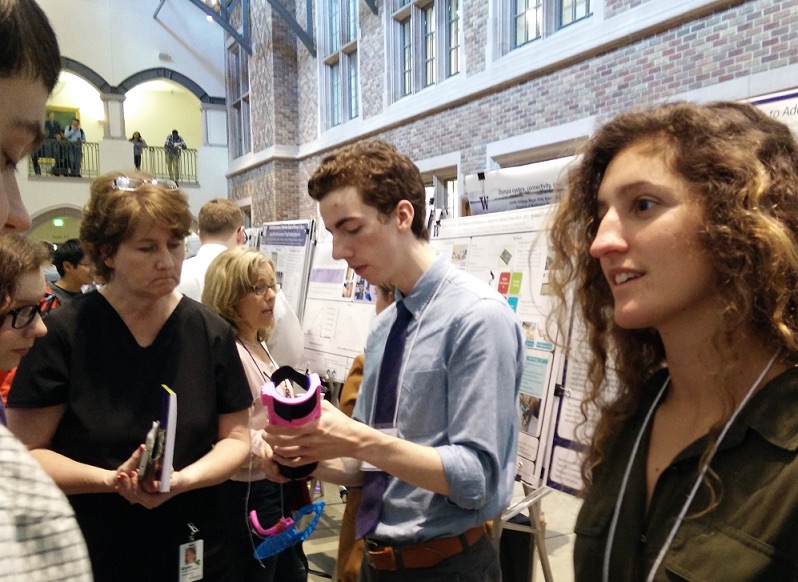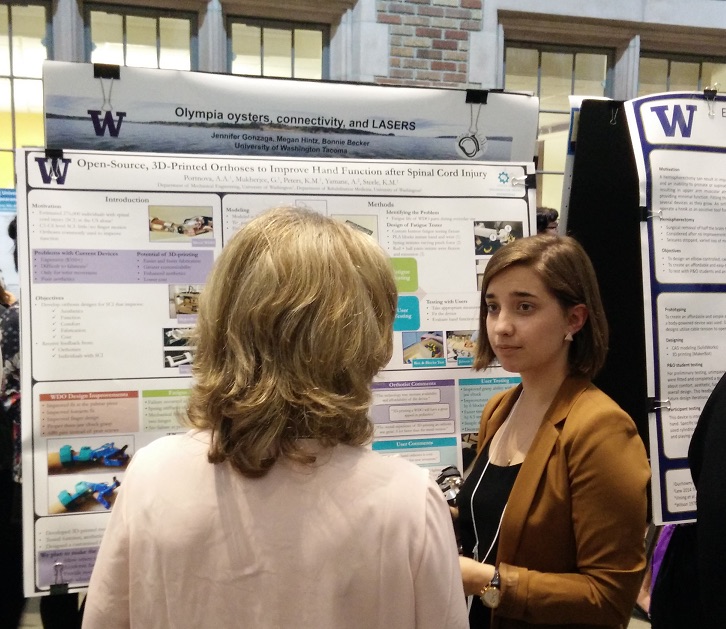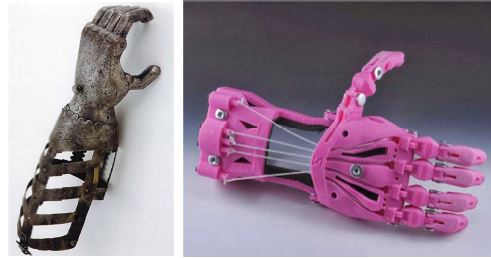
Sasha Portnova is presenting her research at the 20th Annual Posters on the Hill in Washington DC today, April 20th. Out of 300 received applications, Sasha was one of 60 posters chosen for the presentation. She is sharing her work on: 3D-Printed Wrist-Driven Orthosis for Individuals with Spinal Cord Injury. Congratulations and Go Biomechanics!
Projects
Sasha Presents at the Northwest Chapter of AAOP
After presenting her work at the national American Academy of Orthotists and Prosthetists (AAOP) in Orlando, FL, Sasha was invited to present her work locally at the Northwest chapter of AAOP here in Bellevue. Great job sharing about your research, Sasha!
BR Shuman, M Goudriaan, L Bar-On, MH Schwartz, K Desloovere, KM Steele (2016) “Repeatability of muscle synergies within and between days for typically developing children and children with cerebral palsy.” Gait & Posture.

Journal article in Gait and Posture:
Filtering parameters impact the results from muscle synergy analyses.
Abstract: Muscle synergies are typically calculated from electromyographic (EMG) signals using nonnegative matrix factorization. Synergies identify weighted groups of muscles that are commonly activated together during a task, such as walking. Synergy analysis has become an emerging tool to evaluate neuromuscular control; however, the repeatability of synergies between trials and days has not been evaluated. The goal of this study was to evaluate the repeatability of synergy complexity and structure in unimpaired individuals and individuals with cerebral palsy (CP). EMG data were collected from eight lower-limb muscles during gait for six typically developing (TD) children and five children with CP on two separate days, over three walking speeds. To evaluate synergy complexity, we calculated the total variance accounted for by one synergy (tVAF1). On a given day, the average range in tVAF1 between gait cycles was 18.2% for TD and 19.1% for CP. The average standard deviation in tVAF1 between gait cycles was 4.9% for TD and 5.0% for CP. Average tVAF1 calculated across gait cycles was not significantly different between days for TD or CP participants. Comparing synergy structure, the average (standard deviation) within day correlation coefficients of synergy weights for two or more synergies were 0.89 (0.15) for TD and 0.88 (0.15) for CP. Between days, the average correlation coefficient of synergy weights for two or more synergies was greater than 0.89 for TD and 0.74 for CP. These results demonstrate that synergy complexity and structure averaged over multiple gait cycles are repeatable between days in both TD and CP groups.
Webinar: Synergy-based Control in OpenSim
Join us January 27th for an OpenSim webinar lead by our director, Kat Steele.
Details
Title: Synergy-based Control in OpenSim: Coupled Muscle Activity in Static Optimization
Speakers: Kat Steele, University of Washington
Time: Wednesday, January 27, 2016 at 10:00 a.m. Pacific Standard Time
Registration: To register for this event, click HERE. (webinar is free, but registration is required)
Abstract
How humans control movement remains an open question. One theory suggests that muscles may be activated in weighted groups, commonly referred to as muscle synergies, modes, or modules. A small number of synergies have been shown to describe
muscle activity in both animals and humans during tasks such as walking and reaching; however, whether these synergies reflect underlying neural control or other constraints remains unclear. An advantage of musculoskeletal simulation is that we can specify and test different control strategies.
In this webinar, Dr. Steele will discuss an OpenSim plug-in that lets users couple the activation of multiple muscles in weighted groups through static optimization. She will demonstrate applications of this plug-in for evaluating synergy-based control and testing the impacts of variable muscle weightings on tibiofemoral contact forces.
More information about this work can be found within the publication“Consequences of biomechanically constrained tasks in the design and interpretation of synergy analyses.”
Upcoming Webinars for Graduate Students and Academics
Join us for the following AccessEngineering Webinars! If you would like to attend one or more, please register for the respective topic by following the link provided. (Please note, all of the webinars are scheduled in Eastern Daylight Time)
Choosing and Delivering a High Quality Online Program
Friday, Dec 4th, 2015 11:00 am – 12:00 pm (EDT)
About the Webinar:
This webinar will focus on three aspects of distance education: (1) how Kettering University Online develops high quality online programs; (2) how can students choose a high quality online program to enroll; and (3) how can potential instructors find a high quality institution to teach. There will be presentations and Q&A sessions about each aspect.
Presenter: Dr. Christine Wallace
AccessEngineering: Strategies to support individuals with disabilities pursuing careers in engineering – Part 1
Monday, December 7th, 2015 1:00 pm – 2:00 pm (EDT)
About the Webinar:
This webinar focuses on a new NSF initiative, AccessEngineering, which (1) supports and promotes individuals with disabilities in pursuing engineering, and (2) integrates universal design and accessibility topics into the engineering curriculum. In particular, this webinar will discuss topics including communication tips and how you can best support individuals with disabilities in engineering, and best practices for making makerspaces, labs and machine shops accessible.
Presenters: Sheryl Burgstahler, Richard Ladner, Maya Cakmak, Kat Steele, Brianna Blaser
Patents: An Introduction for Inventors, Part One
Friday, December 11th, 2015 2:00 pm – 3:00 pm (EDT)
About the Webinar:
This presentation series is a basic introduction to patents and an overview of issues and practices to be considered by prospective patent inventors and patent owners. Part One focuses on providing a basic overview of patents and need-to-know information for inventors to streamline the patenting process. The basic overview explains what patents are, how patents relate to other forms of intellectual property, what requirements must be met for patenting an invention in the U.S., basic considerations for patenting an invention internationally, and how patents provide value to their owners. The overview of information for inventors covers inventorship and ownership issues, when to file for a patent, how to avoid sinking a patent application with one’s own publications, and various good practices for inventors to follow regarding disclosures and record-keeping.
Presenter: Michael Gamble
AccessEngineering: Strategies to support individuals with disabilities pursuing careers in engineering – Part 2
Tuesday, January 19th, 2016 1:00 pm – 2:00 pm (EDT)
About the Webinar:
This webinar focuses on a new NSF initiative, AccessEngineering, which (1) supports and promotes individuals with disabilities in pursuing engineering, and (2) integrates universal design and accessibility topics into the engineering curriculum. In particular, this webinar will discuss topics including communication tips and how you can best support individuals with disabilities in engineering, and best practices for making makerspaces, labs and machine shops accessible. Part 2 of this webinar series will focus on strategies for easily integrating universal design and accessibility topics into engineering education.
Presenters: Sheryl Burgstahler, Richard Ladner, Maya Cakmak, Kat Steele