Journal article in Gait and Posture:
Filtering parameters impact the results from muscle synergy analyses.
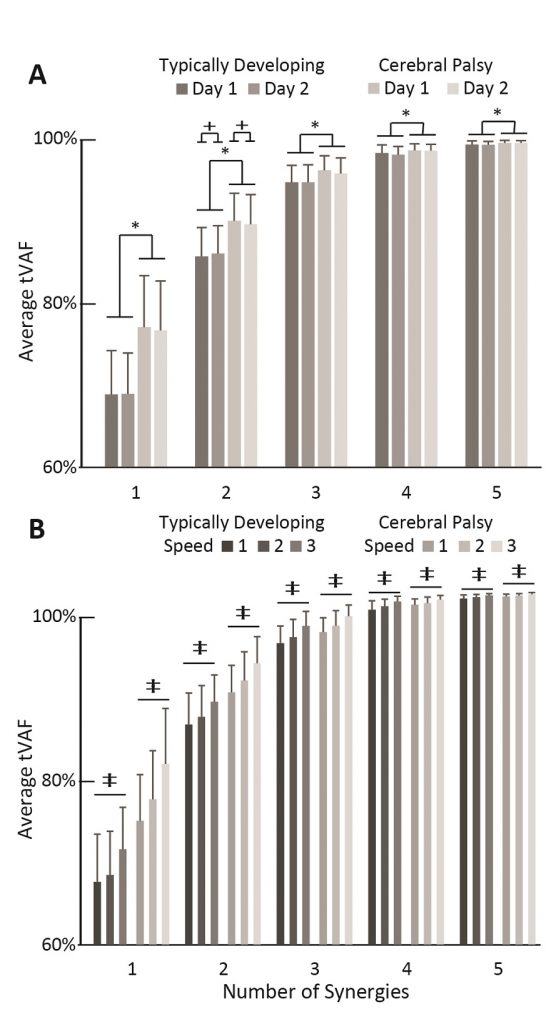 Abstract: Muscle synergies are typically calculated from electromyographic (EMG) signals using nonnegative matrix factorization. Synergies identify weighted groups of muscles that are commonly activated together during a task, such as walking. Synergy analysis has become an emerging tool to evaluate neuromuscular control; however, the repeatability of synergies between trials and days has not been evaluated. The goal of this study was to evaluate the repeatability of synergy complexity and structure in unimpaired individuals and individuals with cerebral palsy (CP). EMG data were collected from eight lower-limb muscles during gait for six typically developing (TD) children and five children with CP on two separate days, over three walking speeds. To evaluate synergy complexity, we calculated the total variance accounted for by one synergy (tVAF1). On a given day, the average range in tVAF1 between gait cycles was 18.2% for TD and 19.1% for CP. The average standard deviation in tVAF1 between gait cycles was 4.9% for TD and 5.0% for CP. Average tVAF1 calculated across gait cycles was not significantly different between days for TD or CP participants. Comparing synergy structure, the average (standard deviation) within day correlation coefficients of synergy weights for two or more synergies were 0.89 (0.15) for TD and 0.88 (0.15) for CP. Between days, the average correlation coefficient of synergy weights for two or more synergies was greater than 0.89 for TD and 0.74 for CP. These results demonstrate that synergy complexity and structure averaged over multiple gait cycles are repeatable between days in both TD and CP groups.