
Journal Article in Journal of Biomechanics
For children with cerebral palsy (CP), interventions that provide support like BWS treadmill training, orthoses, or walkers have been shown to improve walking speed, endurance, and/or kinematics – although responses are variable and challenging to predict.
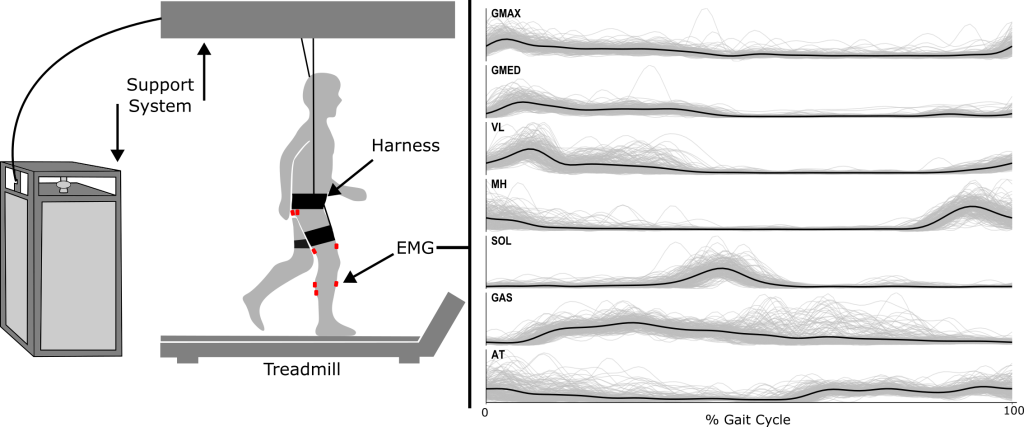
Aim: Body weight support (BWS) is often provided during rehabilitation interventions or activities of daily living with assistive devices for children with cerebral palsy (CP). How individuals alter their muscle activity and coordination in response to BWS provides insight into neuromuscular control and may inform the design of future interventions.
Methods: Children with CP (n = 12) and typically developing (TD) peers (n = 8) walked on a treadmill with 1%, 20%, 40%, and 60% BWS while electromyographic (EMG) data was recorded from 7 lower limb muscles. We computed muscle synergies from the EMG data using non-negative matrix factorization.
Results: As BWS increased, activity of support muscles like the gluteus maximus and gluteus medius decreased for both CP and TD groups. Children with CP had significantly reduced synergy complexity compared to TD peers (total variance accounted for by one synergy, tVAF1 = 76.3 for CP versus 67.4 for TD averaged across all conditions). However, synergy complexity did not change with BWS for either group.
Interpretation: Although BWS may assist mobility by reducing demand on support muscles, it does not directly modulate motor control.
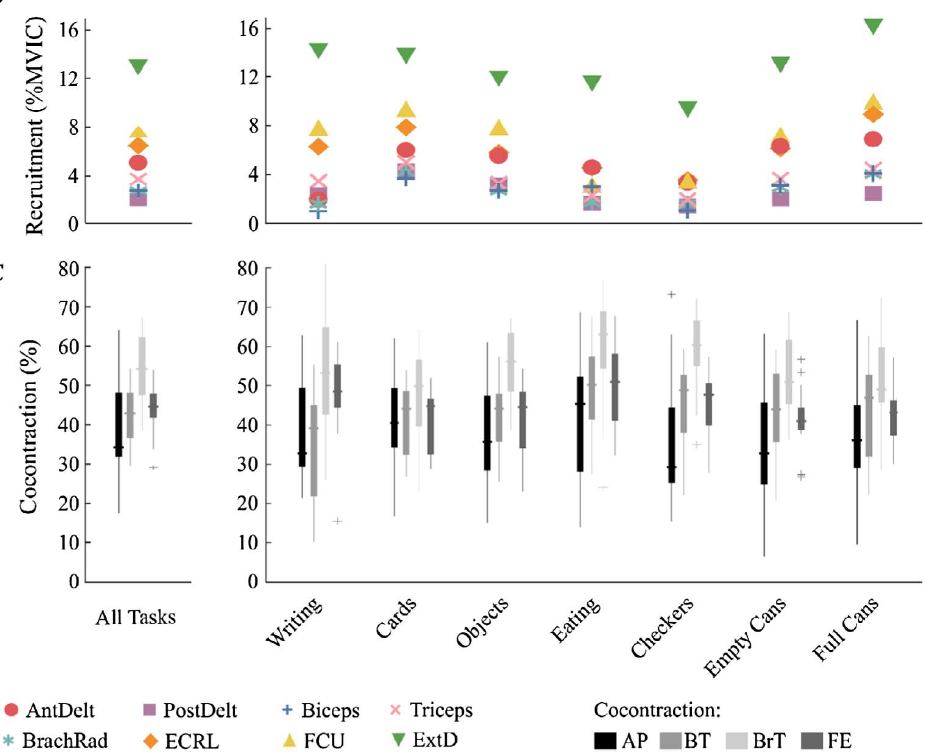 Background: Performance-based tests, such as the Jebsen Taylor Hand Function Test or Chedoke Arm and Hand Activity Inventory, are commonly used to assess functional performance after neurologic injury. However, the muscle activity required to execute these tasks is not well understood, even for unimpaired individuals. The purpose of this study was to evaluate unimpaired muscle recruitment and coordination of the dominant and non-dominant limbs during common clinical tests.