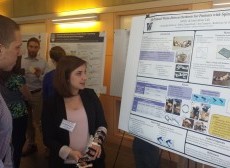
H Choi, KM Rumberger, KM Steele, “Fabrication of customized 3D-printed variable stiffness ankle foot orthoses to evaluate muscle function,” Gait & Clinical Movement Analysis Society (Portland, OR) March 18-21, 2015.

H Choi, KM Rumberger, KM Steele, “Fabrication of customized 3D-printed variable stiffness ankle foot orthoses to evaluate muscle function,” Gait & Clinical Movement Analysis Society (Portland, OR) March 18-21, 2015.

Hwan Choi presents at Gait & Clinical Movement Analysis Society Annual Conference:

Fabrication of customized 3D-printed variable stiffness ankle foot orthoses to evaluate muscle function

Portland, OR (March 18-21, 2015)

Dr. Steele is awarded an NSF CAREER Award!

Congratulations to Dr. Kat Steele on her NSF CAREER Award!

Kat SteeleAs a recipient, Dr. Steele will focus on individuals who rely on orthoses for assistance while walking, such as cerebral palsy and stroke survivors, in order to improve human ability. Neuromuscular control and musculoskeletal dynamics will be modeled from motion capture in order to create simulations. Dynamic simulation provides an ideal framework to specify and test different neuromuscular control strategies and expand our ability to design optimized exoskeletons. For more information, click HERE.

NSF

KM Steele, MC Tresch, EJ Perreault (2015) “Consequences of biomechanically constrained tasks in the design and interpretation of synergy analyses.” Journal of Neurophysiology

KM Steele, MC Tresch, EJ Perreault (2015) “Consequences of biomechanically constrained tasks in the design and interpretation of synergy analyses.” Journal of Neurophysiology

Journal article in Journal of Neurophysiology

Consequences of biomechanically constrained tasks in the design and interpretation of synergy analyses

Matrix factorization algorithms are commonly used to analyze muscle activity and provide insight into neuromuscular control. These algorithms identify low-dimensional subspaces, commonly referred to as synergies, which can describe variation in muscle activity during a task. Synergies are often interpreted as reflecting underlying neural control; however, it is unclear how these analyses are influenced by biomechanical and task constraints, which can also lead to low-dimensional patterns of muscle activation. The aim of this study was to evaluate whether commonly used algorithms and experimental methods can accurately identify synergy-based control strategies. This was accomplished by evaluating synergies from five common matrix factorization algorithms using muscle activations calculated from 1) a biomechanically constrained task using a musculoskeletal model and 2) without task constraints using random synergy activations. Algorithm performance was assessed by calculating the similarity between estimated synergies and those imposed during the simulations; similarities ranged from 0 (random chance) to 1 (perfect similarity). Although some of the algorithms could accurately estimate specified synergies without biomechanical or task constraints (similarity >0.7), with these constraints the similarity of estimated synergies decreased significantly (0.3-0.4). The ability of these algorithms to accurately identify synergies was negatively impacted by correlation of synergy activations, which are increased when substantial biomechanical or task constraints are present. Increased variability in synergy activations, which can be captured using robust experimental paradigms that include natural variability in motor activation patterns, improved identification accuracy but did not completely overcome effects of biomechanical and task constraints. These results demonstrate that a biomechanically constrained task can reduce the accuracy of estimated synergies and highlight the importance of using experimental protocols with physiological variability to improve synergy analyses. PDF