KM Steele, S Brunhaver, SD Sheppard (2014) “Feedback from in-class worksheets and discussion improves performance on the Statics Concept Inventory.” International Journal of Engineering Education

KM Steele, S Brunhaver, SD Sheppard (2014) “Feedback from in-class worksheets and discussion improves performance on the Statics Concept Inventory.” International Journal of Engineering Education

Journal article accepted in International Journal of Engineering Education:

Feedback from in-class worksheets and discussion improves performance on the Statics Concept Inventory.

The Statics Concept Inventory (SCI) is used to evaluate students’ conceptual understanding in introductory mechanics courses. Previous studies have shown that although performance on the SCI improves at the end of a course, performance is often still unsatisfactory with scores well below 100%. In this study, we sought to determine if providing feedback on conceptual topics through in-class worksheets and discussion would improve students’ performance on the SCI. To test this hypothesis, we designed eight multiple-choice worksheets, each inspired by a different topic on the SCI, for use during an introductory mechanics course. In order to evaluate the impact of the worksheets on SCI performance, we divided the eight worksheets into two groups and each group of worksheets was deployed in a different offering of the course. Each worksheet was completed at the end of a class period and, at the beginning of the next class period, the instructor led a discussion of the results and common misconceptions on each worksheet. Students took the SCI at the beginning and end of the course and the change in SCI scores for topics with and without worksheets were compared. Results from both course offerings indicated that the in-class worksheets were effective at improving performance on the SCI, as SCI scores improved significantly more for topics that had worksheets than the topics that did not have worksheets. Furthermore, overall SCI performance at the end of each course was greater than in previous courses. These results suggest that a quick and easy-to-implement addition to the curriculum using in-class worksheets and next-class discussion were effective at providing feedback on conceptual topics, exposing misconceptions, and improving performance on the SCI. The worksheets developed as part of this study are available on-line for other instructors to use (http://del.stanford.edu). The SCI is also free to use and can be found at cihub.org. PDF

MH Schwartz, A Rozumalski, KM Steele, “Muscle synergy complexity is related to selective motor control in cerebral palsy.” European Society for Motion Analysis in Adults and Children (Glascow, Scotland) Sept. 2-7, 2013.

MH Schwartz, A Rozumalski, KM Steele, “Muscle synergy complexity is related to selective motor control in cerebral palsy.” European Society for Motion Analysis in Adults and Children (Glascow, Scotland) Sept. 2-7, 2013.

Kat Steele presents at European Society for Motion Analysis in Adults and Children Conference:

Muscle synergy complexity is related to selective motor control in cerebral palsy

Glascow, Scotland (September 2-7, 2013)

KM Steele, MC Tresch, EJ Perreault, (2013) “The number and choice of muscles impact the results of muscle synergy analyses,” Frontiers in Computational Neuroscience

KM Steele, MC Tresch, EJ Perreault, (2013) “The number and choice of muscles impact the results of muscle synergy analyses,” Frontiers in Computational Neuroscience

Journal article accepted in Frontiers in Computational Neuroscience:

The number and choice of muscles impact the results of muscle synergy analyses

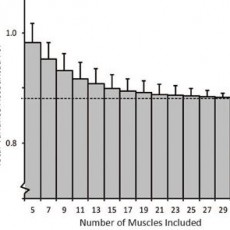
One theory for how humans control movement is that muscles are activated in weighted groups or synergies. Studies have shown that electromyography (EMG) from a variety of tasks can be described by a low-dimensional space thought to reflect synergies. These studies use algorithms, such as nonnegative matrix factorization, to identify synergies from EMG. Due to experimental constraints, EMG can rarely be taken from all muscles involved in a task. However, it is unclear if the choice of muscles included in the analysis impacts estimated synergies. The aim of our study was to evaluate the impact of the number and choice of muscles on synergy analyses. We used a musculoskeletal model to calculate muscle activations required to perform an isometric upper-extremity task. Synergies calculated from the activations from the musculoskeletal model were similar to a prior experimental study. To evaluate the impact of the number of muscles included in the analysis, we randomly selected subsets of between 5 and 29 muscles and compared the similarity of the synergies calculated from each subset to a master set of synergies calculated from all muscles. We determined that the structure of synergies is dependent upon the number and choice of muscles included in the analysis. When five muscles were included in the analysis, the similarity of the synergies to the master set was only 0.57 ± 0.54; however, the similarity improved to over 0.8 with more than ten muscles. We identified two methods, selecting dominant muscles from the master set or selecting muscles with the largest maximum isometric force, which significantly improved similarity to the master set and can help guide future experimental design. Analyses that included a small subset of muscles also over-estimated the variance accounted for (VAF) by the synergies compared to an analysis with all muscles. Thus, researchers should use caution using VAF to evaluate synergies when EMG is measured from a small subset of muscles. PDF